
Why Are Horse Associations So Easy for Scammers to Impersonate?
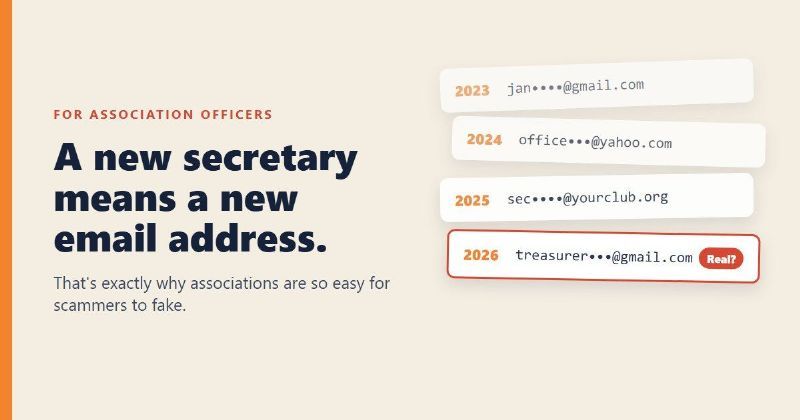
Why are horse associations so easy for scammers to impersonate?
Because nobody expects an association's email address to stay the same.
I figured this out while writing up a scam that went out under my name in September 2026. Somebody emailed our clients pretending to be me, from a Gmail account, asking for $450. For our clients the biggest giveaway was that Gmail address, since we never send business email from Gmail.
Then it hit me that the same giveaway doesn't work for an association at all, and that worries me a lot more than the email about me did.
Why doesn't the email address help with associations?
Think about how association email actually works. A secretary might send from a personal email, the club's email or a work account, and next year there's a new secretary with a whole new set of addresses. Members watch a new address show up every year and nobody thinks twice about it. That's just how associations work.
So a fake email from your "treasurer," asking a member or a sponsor to send their payment somewhere new, would look completely normal. There's no strange address to catch when every address is a little strange.
Who is most likely to get hit?
Anybody who sends the association money. Members paying dues, exhibitors paying entries, sponsors paying for their spot, and stallion owners in a stallion service auction are all people who expect to hear from the association about money, which is exactly what a scammer is counting on.
Treasurers are a target from the other direction too, because paying bills is the job. A fake invoice from a "vendor" lands on the one person whose whole role is to pay it.
What can association officers do about it?
A few things, and none of them cost anything.
Tell your members, in writing, how you take money. Through your website, by check to one address, whatever it really is. Then say plainly that you will never email them a new place to send it. Once you've said that, a "please pay here instead" email stands out like a sore thumb.
Put it on your website where people can find it. Your payment page or your membership page is a good spot, because that's where members will go looking when something feels off.
Use one association email address that stays with the job. Something like secretary@ at your association's own domain, passed from one secretary to the next, instead of whatever personal account the new person happens to use. When members always hear from the same address, a new one is suddenly worth a second look.
Remind them when you're collecting money. Renewal season and auction time are the big ones. One line in the email that's going out anyway is plenty.
What should members do?
If your association ever asks you to pay somewhere different than usual, call an officer you already know before you send a dime. Use the number you've always had for them, not one from the email.
Frequently asked questions
Our secretary uses a personal Gmail. Is that a problem?
Not by itself, lots of associations do it. It just means members can't use the address to tell real from fake, so the other protections matter more.
What if a scammer already emailed our members pretending to be us?
Tell your members that same day. That's the part I got wrong. I reported the fake account right away, but I didn't email everybody that morning, and I should have.
Is this a horse association thing?
Any group that collects money from people who expect emails about money is a target. Associations just happen to be easier to fake than most.
Should we stop sending payment information by email?
You don't have to. Just make sure the payment instructions never change by email, and that your members know it.
Let's talk
If you want to talk through how to set this up for your association, call me at 979-217-1544.
Tom Bruch has built websites since 1998 and is the owner of Big Sky Internet Design.